
Virtual Shooting Range for Police: More Practice, Better Decisions and Less Risk
October 26, 2026
If you run a public security agency, you know the hard equation: your officers need to practice often, but every live-fire session costs ammunition, travel hours and facilities and, above all, carries risk. And still, the public expects every officer to make the right call within seconds.
A virtual shooting range doesn't replace all of that, but it changes the way you train. It lets your personnel practice more often, in more scenarios and with feedback that a traditional firing range can hardly offer. In this article we explain what your agency gains from one and which questions to ask yourself before investing.
What Is Happening in Mexico
Simulator training is no longer an idea for the future. Several agencies across the country use it as part of their ongoing training:
- Mexico City. The Virtual Reality Training Center of the Citizen Security Secretariat has trained about 17,000 police officers in more than three years of operation, according to La Crónica (October 7, 2026). There they practice how to draw, identify real threats and control their emotions in high-risk situations.
- Zapopan, Jalisco. In January 2026, the Police Commissariat opened a virtual and live-fire shooting range with an investment of 96.7 million pesos, which other agencies will also be able to use, according to the Zapopan Government.
- El Salto, Jalisco. The municipality launched its virtual shooting range with a plan for operational officers to train at least once a week, according to Paralelo 20.
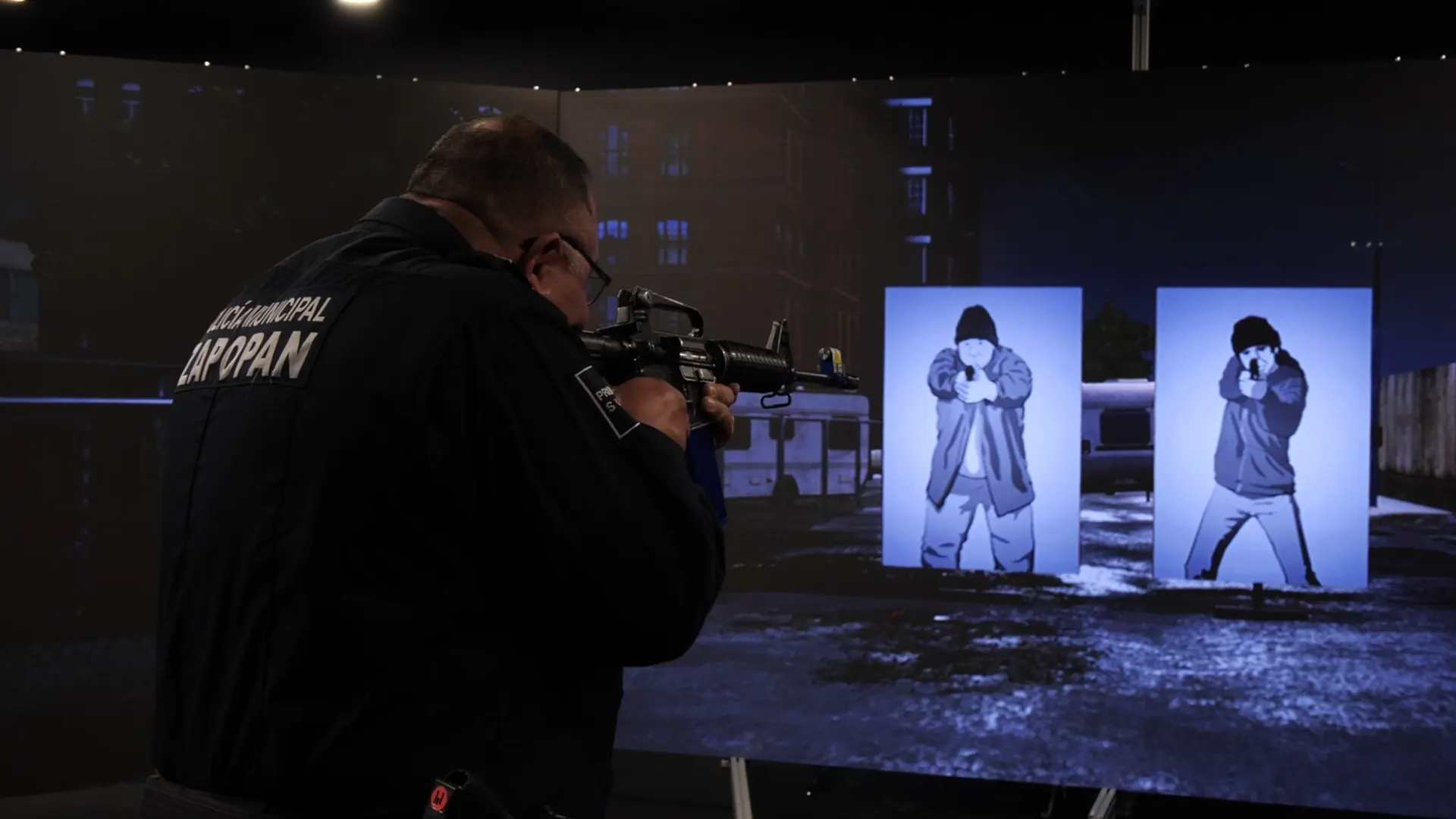
The message is clear: the agencies that invest the most in preparation are betting on frequent practice, not on a single course once a year.
What Your Agency Gains from a Virtual Shooting Range
1. Frequent Practice Without Depending on Ammunition
Every live round has a cost and requires strict control. On a simulator, your officers train without live ammunition, which, as the municipality of El Salto pointed out, optimizes resources. This makes it possible to move from sporadic practice to a constant training routine.
2. Training Decisions, Not Just Marksmanship
Hitting the target is only one part of police work. The most delicate part is deciding when, how and whether the use of force is necessary. Simulators project branching scenarios: the situation changes depending on what the officer does. This is how communication, containment and the gradual use of force are practiced.
This ties in with what the law requires. Mexico's National Law on the Use of Force states that training must consider the differentiated, escalated and gradual use of force, and include evaluation courses. A simulator makes it easier to practice and document exactly that. Even so, always confirm with your legal department and the relevant authority how the regulation applies to your agency.
3. Immediate Feedback
At the SSC CDMX center, the instructor reviews performance at the end of each exercise and corrects procedures before the officer faces real situations. That conversation afterwards, with the scenario still fresh, is where a good part of the learning happens.
4. A Safer, Healthier Environment
Indoor live-fire shooting exposes instructors and shooters to lead and noise if the facility is not properly ventilated and controlled. NIOSH, the United States occupational health institute, warns about this in its alert on indoor shooting ranges. Virtual training reduces that exposure during practice sessions and leaves live fire for when it truly adds value.
5. Evidence to Evaluate and Be Accountable
A simulator records how each participant performed. For an agency, that means having data to identify areas of opportunity, plan training and show the public and oversight bodies that personnel are preparing consistently.
What a Simulator Doesn't Do (and It's Worth Saying)
We want you to make an informed decision. Academic research on whether simulator training translates into better performance on the street is still limited. A review from Carleton University (Bennell and colleagues, 2007) found few studies. It also warned that, in many agencies, each officer's time on the simulator was minimal.
The lesson is useful: equipment alone does not transform an agency. What makes the difference is a program with frequency, scenarios that increase in difficulty and instructors who give feedback. That is why a virtual range works best as part of a system, alongside the live-fire shooting range, theoretical training and periodic evaluation.
Five Questions Before Investing
- How many officers do you need to train, and how often? This defines how many shooting positions and what type of system make sense.
- Which scenarios are really those of your municipality? Ask for a library that includes environments similar to the ones your personnel face: urban, highway, rural or facilities.
- Who will operate the system? Plan your instructors' training from day one.
- How will it fit into your evaluation? Define how you will use the simulator's records in your annual training plan.
- What support and maintenance does it include? Idle equipment trains no one. Ask about response times, updates and spare parts.
Your People, Better Prepared
In the end, a virtual shooting range is not about technology. It is about your officers arriving at every shift with more confidence, making better decisions under pressure, and the public trusting its police. Your officers deserve that preparation, and you deserve a way to demonstrate it.
At RGM Advanced we have spent more than 20 years supporting agencies across the country with virtual shooting ranges, live-fire shooting ranges and comprehensive training solutions. We like to start by understanding your agency: how many officers you have, what challenges they face and what results you want to achieve.
Let's talk about your agency. Message us on WhatsApp at 81 2602 8739 and, together, let's design the training plan your people need.